huggingface/transformers
huggingface/transformers
Activity
Last release
Open issues
Open PRs
License
release notes
release notes
Published 5/8/2025
Pre-ReleasePre-releaseA new model is added to transformers: SAM-HQ
It is added on top of the v4.51.3 release, and can be installed from the following tag: v4.51.3-SAM-HQ-preview.
In order to install this version, please install with the following command:
pip install git+https://github.com/huggingface/transformers@v4.51.3-SAM-HQ-preview
If fixes are needed, they will be applied to this release; this installation may therefore be considered as stable and improving.
As the tag implies, this tag is a preview of the SAM-HQ model. This tag is a tagged version of the main branch and does not follow semantic versioning. This model will be included in the next minor release: v4.52.0.
SAM-HQ (High-Quality Segment Anything Model) was proposed in Segment Anything in High Quality by Lei Ke, Mingqiao Ye, Martin Danelljan, Yifan Liu, Yu-Wing Tai, Chi-Keung Tang, Fisher Yu.
The model is an enhancement to the original SAM model that produces significantly higher quality segmentation masks while maintaining SAM's original promptable design, efficiency, and zero-shot generalizability.
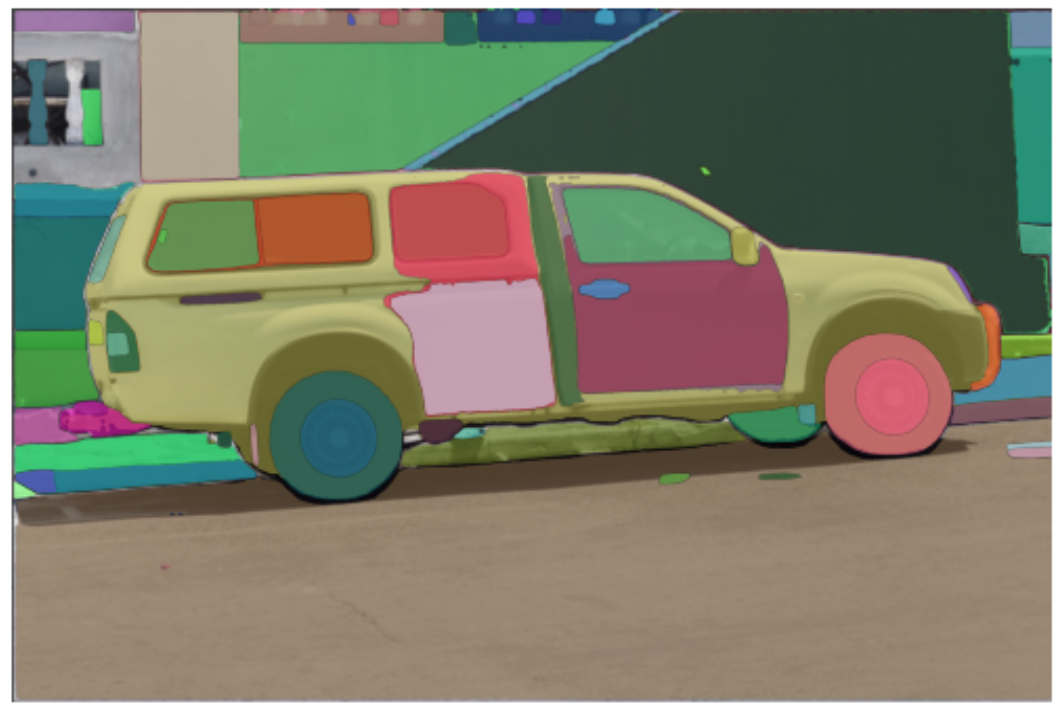
SAM-HQ introduces several key improvements over the original SAM model:
The abstract from the paper is the following:
The recent Segment Anything Model (SAM) represents a big leap in scaling up segmentation models, allowing for powerful zero-shot capabilities and flexible prompting. Despite being trained with 1.1 billion masks, SAM's mask prediction quality falls short in many cases, particularly when dealing with objects that have intricate structures. We propose HQ-SAM, equipping SAM with the ability to accurately segment any object, while maintaining SAM's original promptable design, efficiency, and zero-shot generalizability. Our careful design reuses and preserves the pre-trained model weights of SAM, while only introducing minimal additional parameters and computation. We design a learnable High-Quality Output Token, which is injected into SAM's mask decoder and is responsible for predicting the high-quality mask. Instead of only applying it on mask-decoder features, we first fuse them with early and final ViT features for improved mask details. To train our introduced learnable parameters, we compose a dataset of 44K fine-grained masks from several sources. HQ-SAM is only trained on the introduced dataset of 44k masks, which takes only 4 hours on 8 GPUs.
Tips:
SAM-HQ can be found on the Huggingface Hub.
import torch
from PIL import Image
import requests
from transformers import SamHQModel, SamHQProcessor

device = "cuda" if torch.cuda.is_available() else "cpu"
model = SamHQModel.from_pretrained("sushmanth/sam_hq_vit_b").to(device)
processor = SamHQProcessor.from_pretrained("sushmanth/sam_hq_vit_b")

img_url = "https://huggingface.co/ybelkada/segment-anything/resolve/main/assets/car.png"
raw_image = Image.open(requests.get(img_url, stream=True).raw).convert("RGB")
input_points = [[[450, 600]]]  # 2D location of a window in the image

inputs = processor(raw_image, input_points=input_points, return_tensors="pt").to(device)
with torch.no_grad():
    outputs = model(**inputs)

masks = processor.image_processor.post_process_masks(
    outputs.pred_masks.cpu(), inputs["original_sizes"].cpu(), inputs["reshaped_input_sizes"].cpu()
)
scores = outputs.iou_scores
You can also process your own masks alongside the input images in the processor to be passed to the model:
import torch
from PIL import Image
import requests
from transformers import SamHQModel, SamHQProcessor

device = "cuda" if torch.cuda.is_available() else "cpu"
model = SamHQModel.from_pretrained("sushmanth/sam_hq_vit_b").to(device)
processor = SamHQProcessor.from_pretrained("sushmanth/sam_hq_vit_b")

img_url = "https://huggingface.co/ybelkada/segment-anything/resolve/main/assets/car.png"
raw_image = Image.open(requests.get(img_url, stream=True).raw).convert("RGB")
mask_url = "https://huggingface.co/ybelkada/segment-anything/resolve/main/assets/car.png"
segmentation_map = Image.open(requests.get(mask_url, stream=True).raw).convert("1")
input_points = [[[450, 600]]]  # 2D location of a window in the image

inputs = processor(raw_image, input_points=input_points, segmentation_maps=segmentation_map, return_tensors="pt").to(device)
with torch.no_grad():
    outputs = model(**inputs)

masks = processor.image_processor.post_process_masks(
    outputs.pred_masks.cpu(), inputs["original_sizes"].cpu(), inputs["reshaped_input_sizes"].cpu()
)
scores = outputs.iou_scores
release notes
Published 5/8/2025
Pre-ReleasePre-releaseA new model is added to transformers: SAM-HQ
It is added on top of the v4.51.3 release, and can be installed from the following tag: v4.51.3-SAM-HQ-preview.
In order to install this version, please install with the following command:
pip install git+https://github.com/huggingface/transformers@v4.51.3-SAM-HQ-preview
If fixes are needed, they will be applied to this release; this installation may therefore be considered as stable and improving.
As the tag implies, this tag is a preview of the SAM-HQ model. This tag is a tagged version of the main branch and does not follow semantic versioning. This model will be included in the next minor release: v4.52.0.
SAM-HQ (High-Quality Segment Anything Model) was proposed in Segment Anything in High Quality by Lei Ke, Mingqiao Ye, Martin Danelljan, Yifan Liu, Yu-Wing Tai, Chi-Keung Tang, Fisher Yu.
The model is an enhancement to the original SAM model that produces significantly higher quality segmentation masks while maintaining SAM's original promptable design, efficiency, and zero-shot generalizability.
SAM-HQ introduces several key improvements over the original SAM model:
The abstract from the paper is the following:
The recent Segment Anything Model (SAM) represents a big leap in scaling up segmentation models, allowing for powerful zero-shot capabilities and flexible prompting. Despite being trained with 1.1 billion masks, SAM's mask prediction quality falls short in many cases, particularly when dealing with objects that have intricate structures. We propose HQ-SAM, equipping SAM with the ability to accurately segment any object, while maintaining SAM's original promptable design, efficiency, and zero-shot generalizability. Our careful design reuses and preserves the pre-trained model weights of SAM, while only introducing minimal additional parameters and computation. We design a learnable High-Quality Output Token, which is injected into SAM's mask decoder and is responsible for predicting the high-quality mask. Instead of only applying it on mask-decoder features, we first fuse them with early and final ViT features for improved mask details. To train our introduced learnable parameters, we compose a dataset of 44K fine-grained masks from several sources. HQ-SAM is only trained on the introduced dataset of 44k masks, which takes only 4 hours on 8 GPUs.
Tips:
SAM-HQ can be found on the Huggingface Hub.
import torch
from PIL import Image
import requests
from transformers import SamHQModel, SamHQProcessor

device = "cuda" if torch.cuda.is_available() else "cpu"
model = SamHQModel.from_pretrained("sushmanth/sam_hq_vit_b").to(device)
processor = SamHQProcessor.from_pretrained("sushmanth/sam_hq_vit_b")

img_url = "https://huggingface.co/ybelkada/segment-anything/resolve/main/assets/car.png"
raw_image = Image.open(requests.get(img_url, stream=True).raw).convert("RGB")
input_points = [[[450, 600]]]  # 2D location of a window in the image

inputs = processor(raw_image, input_points=input_points, return_tensors="pt").to(device)
with torch.no_grad():
    outputs = model(**inputs)

masks = processor.image_processor.post_process_masks(
    outputs.pred_masks.cpu(), inputs["original_sizes"].cpu(), inputs["reshaped_input_sizes"].cpu()
)
scores = outputs.iou_scores
You can also process your own masks alongside the input images in the processor to be passed to the model:
import torch
from PIL import Image
import requests
from transformers import SamHQModel, SamHQProcessor

device = "cuda" if torch.cuda.is_available() else "cpu"
model = SamHQModel.from_pretrained("sushmanth/sam_hq_vit_b").to(device)
processor = SamHQProcessor.from_pretrained("sushmanth/sam_hq_vit_b")

img_url = "https://huggingface.co/ybelkada/segment-anything/resolve/main/assets/car.png"
raw_image = Image.open(requests.get(img_url, stream=True).raw).convert("RGB")
mask_url = "https://huggingface.co/ybelkada/segment-anything/resolve/main/assets/car.png"
segmentation_map = Image.open(requests.get(mask_url, stream=True).raw).convert("1")
input_points = [[[450, 600]]]  # 2D location of a window in the image

inputs = processor(raw_image, input_points=input_points, segmentation_maps=segmentation_map, return_tensors="pt").to(device)
with torch.no_grad():
    outputs = model(**inputs)

masks = processor.image_processor.post_process_masks(
    outputs.pred_masks.cpu(), inputs["original_sizes"].cpu(), inputs["reshaped_input_sizes"].cpu()
)
scores = outputs.iou_scores
🤗 Transformers: the model-definition framework for state-of-the-art machine learning models in text, vision, audio, and multimodal models, for both inference and training.